Penedès on foot: 4 walking itineraries between nature and history
Penedès is best understood with your boots on. Roman paths, wooded hills, Iberian archaeological sites, dry-stone constructions and seemingly endless vineyard landscapes: every route is a gateway into the history and nature of a territory that, when explored on foot, reveals its most authentic soul.
Whether you're after a gentle stroll of under two hours or a longer hike to discover heritage and natural surroundings, Penedès has an itinerary tailored to you.
Published: September 2024
1. Route from Sant Sadurní d'Anoia to Subirats along the Via Augusta Penedès
The complete itinerary recreates a linear route along the ancient Via Augusta, the longest road built by the Romans in ancient Hispania, as it passed through the Penedès area. It has 7 stages of low difficulty, between 6 and 12 km, without sharp gradients.
The stage between Sant Sadurní d'Anoia and Lavern runs through a vineyard vallery crossed by some basins and streamflows, mostly dried out or very few remaining water. It is an easy route of 5.6km and 161m of elevation gain and can be done in an hour and a half without stops.
From the Sant Sadurní train station we head towards the center of the town; past the bridge, after the first houses, take the street on the left that goes down towards the Lavernó stream basin. We cross it and continue straight. We pass right in front of the Mas de la Riera and immediately take a path, which for approximately 1.3 km borders the stream, until we find the rise of the Cascarell incline. After a slightly steep coast, we arrive at a group of old famhouses called Can Batista.
We continue along the same path, which passes over the AVE line. Without leaving it, we arrive at the can Batlle stream. Just after the basin, we leave the Camí de Can Batista and take the track on the left that crosses, again, the stream Lavernó and a little further on, the basin of ca l'Artigues. We follow the path from ca l'Artigues until we cross the road BV-2429, a few meters from which is the church of Sant Pere Lavern. At this point you can connect with the next stage of the Via Augusta and keep going or call it a day and go to the Lavern-Subirats train station that is about 250 m away to go back to Sant Sadurní.
2. Route in the regional park of Olèrdola
The Natural Parks network of Barcelona provides you with a wide range of itineraries and signposted routes, so you can easily take on different itineraries following the directions and information panels at the starting points.
This is a 6.5km circular route of moderate difficulty, as it starts in front of the entrance to the Monumental d'Olèrdola complex and descends to reach a negative gradient of 170m to climb right back up. It passes through the most prominent heritage elements of Olèrdola Park and some fountains such as Fontanilles, Ametlló and Alba.
3. Route Serra dels Xops and the archaeological site of Font de la Canya
Circular route that stars in the little gem of Sant Sebastià dels Gorgs, the monastery, and it takes us to witness the landscape of vineyards in the Penedès valley up to the first precoastal hills. On our way back, from Avinyó Nou, we can take a look at the interesting Iberian site of La Font de la Canya, and also the building of Sant Pere d'Avinyó, the ancient spiritual center of the region.
We will leave the small village of Sant Sebastià dels Gorgs, walking next to the old walls of the monastery, where we can comfortably leave the car in the public car park that is right at the entrance to the town coming from Vilafranca.
Crossing the small town, we will take the old Cantallops path, while climbing, always very moderately, following the ridge of the Xops hill. Before that, we will have discreetly crossed the basins of Baix and Gendret. We will follow the ridge to Cantallops and we will leave the houses of the village at our feet, starting an uphill trek towards the path of Cap del Grill through an area where the woods and bushes change the previous landscape. The path will leave us in the middle of the Avinyó Nou village, a suitable place for a short rest.
From Avinyó Nou, we will now head to the Font de la Canya area, a beautiful corner furrowed by vineyards that hosts the Iberian archaeological site where some of the oldest vine cultivation remains have veen found. Therefore, the vineyard here has been part of the landscape since very, very remote times. Seen like this, it is respectful. What constancy!
Very close by, once we are on the Camí d'Avinyó, which will take us back to Sant Sebastià dels Gorgs, we find another little gem, this one from the 17th century: the church of Sant Pere d'Avinyó, a baroque style old parish that replaced another one existing at least since the 10th century and linked to the disappeared castle of Avinyó.
From here, and to finish this walk, we will only need to follow the easy path from Avinyó to our starting point, tracking back a short section of the path we will have walked previously.
4. Ruta de la Pedra Seca a El Vendrell
This is a short circular route around the Molí del Sebastià in Sant Vicenç de Calders, just 2.5 km long, very accessible and clearly signposted, part of the Rutes de Pedra Seca (Dry-Stone Routes) of Baix Penedès. It starts right at the beginning of the old road from Sant Vicenç to El Vendrell (Camí vell de Sant Vicenç al Vendrell), 100 m beyond the village exit and just before the cemetery. You can park in the village square.
The main appeal of the route lies in its many dry-stone features: huts of various types, cisterns, vineyard terraces, cocons (rock-cut water basins) and more. You'll also see typical Mediterranean vegetation and enjoy magnificent panoramic views of the Mediterranean.
A curious and worthwhile stop along the way is the Molí del Sebastià itself, a complex made up of the tower of an old flour mill, the threshing floor and the livestock pen with the small shepherds' dwelling.
It once belonged to a cousin of the playwright Àngel Guimerà.Baix Penedès is one of the Catalan regions with the most significant dry-stone heritage, a traditional building technique recognised by UNESCO as Intangible Cultural Heritage of Humanity.
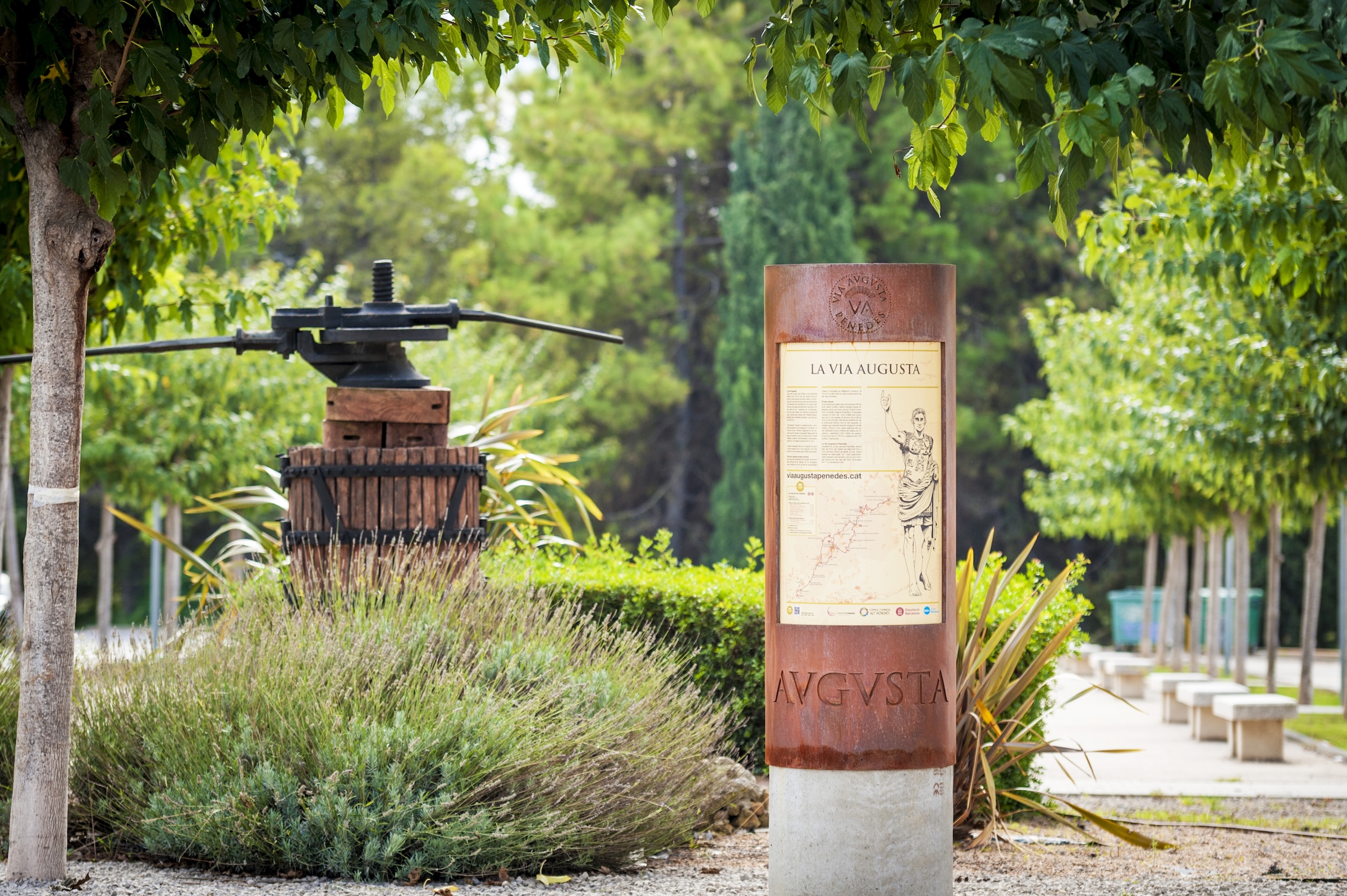
Photo: Carles Fortuny